Thursday, January 26, 2006

She Thought She Was A Woman, But She Was Another Man

I want to talk about a book I read some time ago called A BROTHER'S PRICE by Wen Spencer. Set in ubiquitous fantasy/stock science fiction alternate universe, this is a fairly straightforward gender role reversal story. On this unnamed Earth-like planet (complete with horses, steam power, and European feudalism), men are rare. Women do all the heavy lifting and the men are left in charge of raising children and keeping house. Our hero, Jerin Whistler, is the prettiest and most fertile boy in the all land. When a princess ends up nearly dead on his family's doorstep, sexual hijinks ensue.

Actually, I found the sexual situations fairly entertaining. Admittedly, this is a fantasy I like to play with myself. I've even started a few role-reversed stories of my own (though none are finished, see entry regarding my problems with short stories below) and I even have a dystopian matriarchy, which involves an alternate future Russia that I've been noodling around with in my own head for years.

Plus, my own life lends itself to thinking about gender and gender roles a lot.

I had a very weird problem with this novel. It pushed all my buttons, but none of them hard enough. It's a strange complaint to say, "Hey, you didn’t piss me off enough."

I think in a lot of ways this is a really ambitious novel. Or, maybe it could have been, and that's what bothers me. My sense is that all my big questions with this novel were accidental. Spencer seemed to be playing up the titillating aspects of all of this, rather than bringing the gender/sex question to the forefront.

After a couple of days of mulling this book over, I started asking myself, what was Spencer thinking when she wrote this? Was she actually intentionally making some kind of statement about gender and society? In many ways, our hero, Jerin, could just as easily have been a woman. Though I think there would be a fair number of feminists out there (probably including myself) who would have cried bloody murder if she had written this book with Jerin cast as a woman. The number of times he's threatened with rape alone would have pissed me off. The things that are vaguely titillating about his situation (the way women grope him, the words they use to discuss, crudely, having sex for procreation with him, how he’s treated like property, and the amount of money he’s "worth") would be completely offensive if he were a woman.

Then, I thought, well, Tate, you sexist pig. They're plenty offensive as they're written. And, that could could be the point. Pretty subversive on Spencer's part.

But, at the end of the thing, I decided that I was once again just thinking too hard. It seemed to be meant as a kind of science fictional Regency romance, all meant in a tongue-and-cheek, wink-wink-nudge-nudge kind of way. (The very last line in the book was my tip off.)

Wednesday, January 25, 2006

Yes, But What's the Hypothesis?

Do you ever wonder if someone is running a social experiment on you?

On my way to taking my partner to work the other day, I discovered, of all things, a plastic pot -- the kind you might, in a less inclement season, find an ivy growing in -- sitting on the last step in front of my house. I had a brief moment where I thought, "I could walk around this." But, I didn't. I picked up and threw it into the garbage bag I keep in the back of my car.

Today... there was a newspaper in the exact same spot.

Okay, who ever is out there, yes, I am compulsive about picking up what I perceive as garbage in front of my house.

Stop it all ready. You're making me crazy.

Monday, January 23, 2006

At Home in SF/F

It's interesting to hear Elizabeth Bear say she's also on the look out for queer folks in novels she reads. And that finding them is like finding home.... or at least suddenly feeling more welcome.

There are many reasons I read. One of the reasons science fiction and fantasy keeps me coming back is because it is one of the few places in which an odd duck like myself can reliably find a reflection on the page.

I think that's why this issue of diversity is so important to me.

I remember having my heterosexism kicked in the teeth by Elizabeth A. Lynn's novels, which I read in high school. She not only made me realize when I was fourteen that people of the same gender could love each other, but also she made me really take a hard, cold look at my gender assumptions, in general. Who says "soldier" automatically means "male"? Who says "artist" is more likely female?

These questions have haunted me my whole life. When I see a science fiction show with the ubiquitous male space ship captain, I ask myself, why? Why is the captian a man? Why is white (if he is)? Why is he straight (if he is)? What else is out there?

Of course, I ask these same questions when watching commericals, driving my friends and relations absolutely spare. A real quote from me: "Honey, did you notice the guy selling the matresses is the white guy with perfect teeth and the people who can't seem to find a decent bed are the black couple?" Real response from significant other: "Could you just not think for five seconds?"

I blame Elizabeth A. Lynn.

Friday, January 20, 2006

Don't Ink and Drive: Writing and Responsibility

Still thinking -- which is probably dangerous -- about my previous post. Zoe commented that a writer who includes queer folks in the background runs the risk of seeming ham handed in their attempts at inclusion (or diversity or whatever you might want to call it.) This is a conversation I've had with other people (and on this blog, see below "The Whiteness of Space") about race/ethnicity, too.

There's a lot of validity in her concern. I grew up in the era of television "tokenism," where every show seemed to have to include the hero (white guy), the sidekick (black or other color guy), and the girlfriend (not guy). It was annoying, if only because the formula wherein the person of color was still stuck on the sidelines was never, ever violated.

On the flipside, I find TV shows (and movies and books) where there's a homogony of color (or gender or sexual preference) to be deeply, deeply frightening. It's the whole "Friends" phenomenon. How is it that these people who lived in New York City never seemed to know anyone of color? Or gay? And what does it say about them that they don't?

And does it matter?

Sure, people live like that. I would be forced to admit that ninety-percent of my close friends are white and straight. The "Friends" phenomenon is its own kind of truth, but I've always felt that a writer's responsibility is to see the whole picture – beyond the assumptions. Like, for instance, before I worked at the University of Minnesota's Immigration History Research Center, I would have guessed that the majority of immigrants settling in Minnesota were Norwegian, and that Saint Paul’s (my home town) main settlers were Irish. Not true. Both of those are myths perpetrated by storytellers, like Garrison Keillor (and the later by our former governor Jesse Ventura.)

I'm not trying to imply that either of those men are racists, but my feeling is that sometimes by not going beyond what we *think* is true, we inadvertently paint a picture that's not complete.

So what? Fiction writing isn’t about the truth, is it?

I think it is.

I think, in particular, when writing about the future, we need to be awake and paying attention to our words on the page. Our silences -- the people we leave out -- speak volumes about what we think is true... and what we feel is valuable.

I say this as someone whose life was changed by reading science fiction. In 1953, Theodore Sturgeon wrote a short story called "The World Well Lost," and he taught me the power of thinking beyond our assumptions.

Wednesday, January 18, 2006

Oh Look, Honey, the Gay Hustler is Cruising the Martians

I woke up this morning thinking a lot about something Melissa Scott once told me in an interview. We were discussing GLBT/queer content in science fiction and she pointed out that, particularly in cyberpunk, GLBT elements are often used as scare tactics -- a way to show the seedier side of life. You know you're in the deep, dark place because Jo-Jo sitting at the bar is a transsexual cyborg. Oh look, honey, the gay male hustler is getting cruised at the space station by the Martians. We must be in the dark underbelly of the future.

Where are the non-threatening, happy gay couples in space?

Of course, as a writer I understand that happy = boring. There's not a lot of drama when everyone gets along famously. But, I'm wondering if science fiction as a genre still hasn't shaken that idea that Melissa suggested nearly a decade ago -- that queerness is inherently "scary."

In the last year, I read nearly every paperback science fiction novel published in the United States (this is not an exaggeration, I was on a SF award committee). And, I have to tell you that the GLBT community was woefully under-represented.

In Elizabeth Bear’s series, we find out in the second novel that the main antagonist is a Family man, and has a husband in Toronto. Kudos to Bear for blindsiding me since my gaydar didn't go off on that one, and she did make me ask myself, "Why couldn't he be gay? Was I being heterosexist?" Shame on her for introducing the husband (and his very nice parrot) and killing them off at the end (often the usual fate for gay folks in the media.)

I would say, though, however, that Valens and his husband (of the above mentioned Scardown,) were, at least, nice men. They had a typical upper-middle class life in future Canada. Valens was of squishy moral character, but then so was the hero of the series.

So, at least some GLBT people in the future are non-threatening... but, then it's easy to be non-threatening when you're dead.

Then there’s Karin Lowachee's Cagebird. A difficult book, though a worthy one. However, there's no question that the gay people (and they're all men) in this book are broken, and broken very badly. They're broken in a way that is, sadly, very true to real life -- at least in my experience, but none-the-less this is far from the feel-good GLBT book of the year. There's some serious sickness here, and the sickness is wrapped up in being queer, and, specifically, in knowing that often in society one man's expression of love is another man's kink. This leads to ugliness and heartache. The book is about that, and about what that does to people.

I can’t think of a single other instance in a paperback novel this year in which there were even queer people present in the background. I don’t know what to think about that. Maybe people have been Will & Grace'd to death, and no one wants to even imagine a future with gay people in it. Or maybe GLBT people are no longer scary enough to even sit in the background so that the reader knows that we're not in Kansas any more.

Thursday, January 12, 2006

Getting the Itch Again (Somebody Stop Me)

I woke up this morning with the desire to write another short story.

"So what," you say, "Sounds great. Go for it." No, you don’t understand. This is an incredibly bad idea. Why? I suck at writing short stories. Worse, to paraphrase Marlin from Finding Nemo, I think I can do these things, but I just can't.

I imagine myself a fairly competent novelist. Certainly, I've written my share of them. I seem to understand the process of writing a novel at least well enough to get to THE END. Starting a short story seems to be the best I can do. I usually stall out a page or two into the thing.

I suspect the reason I don't finish most of the short stories I've started is because of the way I write. I've written to outlines for my novels, but more often than not I feel my way into the story. I dilly-dally for several pages before I really know what the novel is about -- both in terms of plotting, but, perhaps more importantly, in terms of theme, as well.

This is the stuff I have to know when I start a short story. If I don't know what the theme or the plot (especially the ending) is going to be before I start, there's no way I can wrap the thing up in 5,000 words or less.

5,000 words is nothing to a novelist. That's not usually even my first chapter. I'm just getting revved up in those first thousand words, not even thinking denouement, for god's sake.

Plus, for me, writing a short story ends up being a weird kind of time commitment. It takes me months to write a short story, plus then I figure in critique and revision... and suddenly, four or five months have gone by and I haven't written a damn word on my novel due to the publisher in August, you know?

So, like I said. Stop me. For crap's sake, someone stop me.

Monday, January 09, 2006

What Makes a Hero?

I finally saw the last "Star Wars" movie Revenge of the Sith and I didn't hate it as much as I expected to.

This, I should point out, is a major admission from me. I once carried on a year long argument over e-mail with a guy I met at a friend's wedding about how betrayed I felt by Phantom Menace and the subsequent (and, in many ways worse) Attack of the Clones.

Yes, I know I'm a geek and I need a life. Listen, I write SF/F, this *is* my life.

But, I have to give He-Whose-Name-Should-Not-Be-Uttered-(Lucas) a tiny modicum of respect for what I felt he was trying to do in Revenge. For once in a Lucas film, what I liked was the political intrigue.

I wish, in fact, there had been a bit more of it. What was missing for me was a better sense of how corrupt the Jedi had become. When Mace Windu insists that they must kill Emperor Palapatine he says something about how the justice system is completely in Palapatine’s pocket. All we have at that point Windu’s word on that. So, there’s really no conflict when Skywalker-soon-to-be-Vader is horrified.

However, that’s a great moment. It suddenly makes the Jedi into the street wise cops who end up bent because they want justice so badly they’re willing to be unjust to get it.

If only that could have been set-up a bit more... there was even a perfect moment to insert it. One of the first scenes we’re given is the rescue of Palapatine where, when Obi-Wan is knocked out, Palapatine orders Skywalker to kill his captor. I’d have liked a sense of Skywalker’s outrage that that point. I would have liked to see him stand up to the Senator and say, "No, we take him to justice." And then have a small scene where the justice system completely fails Skywalker.

Because then, when the moment comes up, we would know. And, more than that, Skywalker would know. Yet, he could STILL be horrified to hear a Jedi say this.

Especially after having been asked to spy on his friend.

Which is another set of scenes I would have liked expanded. I wanted Skywalker to be a lot less naïve. I thought, in fact, it would have been interesting to see him become a true spy. Playing Jedi off Emperor and visa versa, and in the process discovering the wickedness of both sides and becoming more and more disgusted with the whole political game.

I could relate to that. It would make Skywalker much more sympathetic, in my opinion. And his transformation fairly believable.

On a similar note, I totally dug the way the Jedi treated Skywalker (sorry, I can’t call him Annikin, it’s such a stupid name). I loved the scenes were he’s left behind and left out. That really underscored how much they never trusted him... which again, I’d have played up by having Skywalker really turn spy against them (while also working for them).

The only major problem I had with all of this is that the guy who says he doesn’t want to kill Emperor Palapatine turns around and kills Windu (for wanting to kill Palapatine.) This is not a very consistent philosophy. He then, ten minutes later, goes off and slaughters children in the service of Palapatine, which, in my opinion, makes absolutely no sense given his character up to this point. (Which is why Lucas had to include the stupid subplot about Padme and necromancy -- another Knights Templar reference for those of you who are counting).

As a good counter, I offer you Bruce Wayne of Batman Returns.

I was really enamored of the whole issue of compassion in Batman Returns.

(Skip this line if you haven't seen the movie). There's a major scene when the young Bruce Wayne is learning the ninja arts from his mentor Qui-Gon Jinn, er, whoever Liam Neeson is character is... and the mentor says to Bruce, "Your enemies will show no compassion," and Bruce replies, "That's why it is so important to have."

I have always maintained that a hero need to distinguish himself precisely in this way. The first Batman film shocked me when Batman killed the Joker. As a long time reader of comicbooks (though I'm mostly a Marvel girl, myself), I was very used to the idea that heros are not the killers. Villians (especially long time nemesises, like the Joker) come back and back and back because that's the line which is never crossed by a good guy... that's what makes our heros, well, heros.

Villians are supposed to live, stand trial, go to Arkham Asylum... just like Skywalker says they should.

Friday, January 06, 2006

Erotic Dark Fantasy: Things that Do More than Go Bump in the Night

Another stolen idea for a blog from Catherine Lundoff:

"Stories detailing the romantic and sexual relationships of vampires, werewolves and other critters have been popular for years and are only getting more so. What's the allure? Who does this well? Would you really want to do the nasty with someone who smells like a wet wolfhound?"

No, and I also wouldn't want to have sex with someone whose skin is dead... and cold.

I actually have my character in Tall, Dark & Dead talk about this. In Garnet's own words she says: "The fact remained that he was dead. As a doornail. And dating doornails was no fun. Trust me, I tried being with a dead guy once and it was miserable. I found that whole cold skin thing a big turn off in the bedroom. You can only do so many things in a hot bath or shower, and even then the heat didn't... well, penetrate, if you know what I mean."

This was one of those contemporary fantasy moments where the reality, if you will, of having sex with an animated corpse makes for a humorous reflection by the main character. I intentionally asked myself the question Catherine wants the panel to consider: what nitty-gritty, true-life details would you encounter if you took a supernatural being to bed?

I also have Garnet deal with the fact that vampires are nocturnal, and eighty percent (smaller? higher?) of the world is not. Like the majority of people, Garnet has a day-job. Dating someone who comes out after sunset is hell on one's sleep schedule. I know a lot of people who exist on very few hours of sleep at night, but I'm not one of those. Even though I can do short bursts of late-night living, I find I generally need to get eight hours of sleep (or more!) or I get really cranky. And, part of how I deal with writing contemporary fantasy is asking myself: what would it be like for me? Thus, Garnet ended up skipping a lot of work to nap.

The question is actually a gnarly one, because there is a kind of line you have to walk when you write fantasy. Getting the details "right" makes the story ring true, but if you were to say go into great detail about sleeping with a corpse you run the risk of losing a large percentage of your intended audience (minus, of course, the necrophilics.)

I guess the answer is to put in just enough to keep things real and willfully ignore the rest.

Thursday, January 05, 2006

Van Helsing's Heirs

In keeping with my theme of 2006, this is another stolen discussion topic from the MarsCON programming ideas page. This one comes to us curtsey of Minneapolis/St. Paul writer Catherine Lundoff.

Catherine asks her panelists to consider these questions: Are slayers and hunters heroes or villains? Why do the vampires (or other critters) so often win in the end?

I think these are interesting thoughts because for me they tap in a question I asked myself at the very beginning of this blog: what on earth makes vampires so damned sexy?

Van Helsing should be the hero. I think when Dracula was first published in 1897, Van Helsing was meant a force of good in the novel. Dracula is a seductive evil that spoils the virtue of young Ms. Mina Murray (among others).

But when I review my memories of the novel, I can hardly give you any concrete impressions of Van Helsing's character. In fact I had to look up in Wikipedia to see if reading about him sparked anything. http://en.wikipedia.org/wiki/Abraham_Van_Helsing

Nope.

Dracula, however, is singularly memorable. The book is named after him, after all, and not for the slayer.

So, why isn't Van Helsing the hero?

I think that the problem comes from the fact that even at their most alien (when being cast as demons in "Buffy, the Vampire Slayer" or even as alternate species or space aliens) vampires are often depicted as very "human." In a way, they're kind of uber-human because they've left all the mundane trappings of life behind and have been reduced to humans at their essence (blood?) as hunter/predators (which we all know we are, deep in our hearts.)

And, as I've discussed previously, I find that kind of Romantic (with the capital R) vampire to be the most successful. A good hero needs a good villain. And, if the vampires are just mindless, hungry beasts, then their hunters might as well be shooting quail or ducks for all that the story interests me.

So the hunters have to be morally ambiguous. They're killers. And one of the big questions vampire literature asks us is -- aren't we all?

That's why the critters often get away in the end. It's a big, fat morality play in which two sides of the same dark coin are being played out. Van Helsing representing the "moral" killer, the one who kills for "justice" and with the trappings of the Church (crosses, holy water, etc.) vs. the unrestrained beastial passionate killer who feeds on others for self-serving, self-indulgent reasons.

Both are evil. But I think the modern reader comes to the self-righteous killers with a lot more baggage, a lot less willingness to forgive. He is the Inquisitor, the House Committee on UnAmerican Activities....

The vampire is just our passion -- our lust for life -- gone a little too wild.

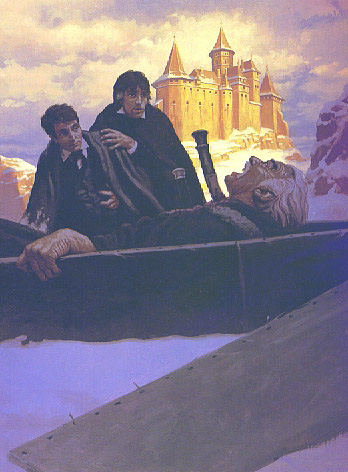
The image for this post came from http://www.olemiss.edu/courses/engl205/dracdeath.html

Wednesday, January 04, 2006

Contemporary Fantasy -- Where Elves are Sexy

... and Available.

The title of this blog is taken from a list of programming ideas for Marscon. This particular idea was submitted by Minneapolis writer Paula Fleming.

Paula asks the panelists to consider this question: Contemporary fantasy often juxtaposes elements of old mythologies with cell phones and fast food. What do we find so compelling in this mix?

I thought I'd answer it here (and hopefully also on the panel.)

For me, the answer is: who doesn't want to meet an angel at McDonald's

Part of the reason I find "contemporary fantasy" or urban fantasy or paranormal romances so compelling is that, when done well, they give the reader the illusion of "it could happen."

Plus, I don't know about y'all, but I've spent a large part of my life in the realm of make-believe. When I was a kid, I chased my share of imaginary villains through the very real forests of Grandad's Bluff. But, then there was also... yesterday, when I was waiting in the doctor's office and I imagined what it would be like to be an international jewel thief. My imagination didn't switch off after I reached the age when it was no longer socially acceptable to play pretend in the woods with your school buddies. So, I guess the contemporary fantasy element appeals to the part of me that would STILL like those fantasies to be real, here, in my world.

Also, I think there's something inherently funny about an elf in a 7/11. I think that the format of the contemporary fantasy is one that allows us to look at both the mundane (the 7/11) in a new and possibly amusing way, but also to poke fun at all of the high fantasy stuff (the elf) we grew up reading. There's a lot of tongue-in-cheek that goes on in the works of, say, MaryJanice Davidson or Rachel Caine, like when your million year old djinn has to deal with... I don't know, pumping gas. It's not surprising to me that a lot of the popular contemporary fantasy is also intentially humorous and light.

It's funny because, in a lot of ways, the more ridiculous the situation, the more "real" the fantasy feels. This isn't always true, but I really enjoy it when, for instance, the vampires in the various chick-lit books I've read have to deal with the particulars of their existance. These kinds of questions (like how DOES a vampire get rich when he can only come out at night) obviously fascinate me (see several previous blogs). In fact, I find that the more those sorts of things are thought about and dealt with in contemporary fantasy the more the paranormal characters seem REAL.

And that appeals to my magical side, if you know what I mean.

If readers of this blog happen to be in the Minneapolis/St. Paul area on the weekend of March 3-5, 2005, they should check out Marscon's main web page for details.

Tuesday, January 03, 2006

A New Year of Reading

Instead of doing the usual post about books I enjoyed in 2005, I thought I'd put together a list of books I'm looking forward to reading this year.

WORLD-WIRED by Elizabeth Bear. I'm actually reading this book right now. It's the conculsion to Bear's Jenny Casey series that started with HAMMERED.

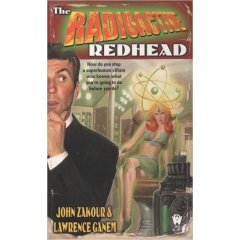
PLUTONIUM BLONDE and DOOMSDAY BRUNETTE by John Zakour and Lawrence Ganem. Both of which are the prequels to RADIOACTIVE REDHEAD, which I reviewed below. If you like fun, fast, and funny science fiction, then these books are for you.

WARCHILD and BURNDRIVE by Karin Lowachee. Dark SF. A worthy read, however.

POLARIS by Jack McDevitt. I don't know nothing about this bok except that Shawn recommended it to me.

And that's what's on the pile for now.

P.S. I resolve to be a better blogger in 2006.

Monday, December 19, 2005

I've been Tagged!

Michele Hauf tagged me, so I'm going play the game and her seven questions:

Seven Things to Do Before I Die:

(1)--Become a member of the exculsive University Club on Summit Avenue. (Really, all I need is money to join, so I guess "make some money" should really be the answer instead) and/or attend a "Renaissance Weekend."
(2)--Be a best-selling author.
(3)--Learn Gaelic
(4)--Win a Hugo
(5)--Punch or be punched by Harlan Ellison
(6)--Be asked to be a commencement speaker at my alma mater (either high school or college) and turn them down.
(7)--Edit my own science fiction/fantasy magazine.

Seven Things I Cannot Do

(1)--Spell "Cannot." (I always think it's can not.)
(2)--Read quickly. (I have mild dyslexia.)
(3)--Drive a motorcycle. (Though I'd like to).
(4)--Dance. (I do it anyway, but, really, anything that requires coordination is out of my league.)
(5)--Leave the table without one more taste.
(6)--Keep my mouth shut. (I love to argue. It's actually my religion -- I was raised Unitarian.)
(7)--Answer questions like this concisely.

Things that Attract Me to Men

(1)--The "ratio." (Shoulder to waist.) Like my character Garnet, I do so love that triangular shape.
(2)--A sense of humor. (Has to have one, to get along with me.)
(3)--Brains. I dated a "gnarly" California surfer boy once who was quite pretty in my opinion, but, really, at the end of the day I like them at least as smart as me, which isn't actually asking for a whole lot.
(4)--Hair. I'll admit it. I like a guy with good hair. It doesn't have to be long or short (or even there, a bald guy can be very hot), but I can't stand it when otherwise hot guys like Brad Pitt get what I call the stupid-boy cut. Do something intentional with your hair, guys. And for God/desses' sake, DON'T CUT IT YOURSELF. See a professional.
(5)--A sense of adventure. Even if he's an armchair warrior, I like that warrior.
(6)--Fearlessness. I want a man unafraid of love.
(7)--Fangs. Okay, not really, but I saw them, I'd be very, very intregued.

Seven Things I say Most Often

(1)--"Dude, get out of the way!" (While driving.)
(2)--"Oops."
(3)--"Wait, wait.... one more thing."
(4)--"Actually, if I may interject..."
(5)--"If I had a million dollars, do you know what I'd do?"
(6)--"Just once it would be cool to win." (While losing at Hearts or Mah Jongg or Scrabble or....)
(7)--"I love you, even though you vex me." (To Mason and my SO.)

Books or Series I Love

(1)--The Weather Warden Series by Rachel Caine
(2)--Wandering Stars: An Anthology of Jewish Fantasy and Science Fiction edited by Jack Dann.
(3)--Nueromancer by William Gibson.
(4)--The Retrieval Artist Series by Kristine Kathryn Rusch.
(5)--Fahrenheit 451 by Ray Bradbury.
(6)--The Marid Audran series by George Alec Effinger.
(7)--The Stephanie Plum series by Janet Evonivich.

Movies I Can Watch Over and Over

(1)--"Star Wars: A New Hope."
(2)--"Bladerunner."
(3)--"The Matrix."
(4)--"Pillow Talk"
(5)--"Ladyhawke."
(6)--"Lost Boys."
(7)--"Sprited Away."

People I Want to Join In (Tag You're It)

(1)--Naomi Kritzer
(2)--Peg Kerr
(3)--Any of the Vampire Vixens
(4)--Rachel Caine
(5)--Neil Gaiman
(6)--Sharon Stiteler
(7)--Will Clark

Thursday, December 15, 2005

Another Good Book

I have another book to recommend. It's by Ann Tonsor Zeddies and it's called BLOOD AND ROSES: A JAYNE TAYLOR NOVEL. It comes out from Phobos Impact and it's a science fiction alternate history book, not unlike the Jay Lake book I talked about earlier. Only this one takes place in the Jazz Era. Bootlegging, Aliens, and "an insidious conspiracy involving the Empire of Japan." How can you go wrong?

You can't.

Tuesday, November 29, 2005

Remembering How to Write

It's the weirdest thing.

Every time I finish a novel, I go through a period -- usually a couple of months -- where I completely forget HOW to write. I remember that I'm supposed to put words down on the paper, but I forget how to make them "sing," you know? I usually try to eke out a short story or something (see previous entry about erotica, which I finished, btw,) and end up feeling like writing sucks and I wonder how the hell I'm ever supposed to be able to do this again.

I imagine what it's really about is my brain begging for a break. Science fiction writer Alan Steele talked about it once as needing time for input, (as opposed to output.) So, I took Mr. Steele's advice and read a lot of stuff... and walked around in the snow with my son.

It seems to have paid off, last night, for the first time in what seems like forever, the floodgates opened and words poured out. I actually had to tell myself it was time to quit, since it was getting late and my son wakes the household up at 5:00 am every morning.

I like writing again.

Hooray.

Tuesday, November 22, 2005

Recommended Books

It's Thanksgiving break and I should be writing.

Instead, I've been reading like crazy. I just finished a great book called RADIOACTIVE REDHEAD by John Zakour and Lawrence Ganem. As they say in my hometown, it's a hoot. I highly recommend it to anyone who loves a good romp and silly, over-the-top humor. According to amazon.com it's not out until December 6, 2005, but order it now. It'll make a great stocking stuffer, IMHO.

I'm now onto Jay Lake's ROCKET SCIENCE. A complete shift in gears (going from a futuristic PI with a transexual AI implanted in his head to a period piece involving NAZIs and alien space ships), but I'm also really enjoying it. I'm a relatively slow reader thanks to mild dyslexia, but I picked up Lake's book today and I'm half way through with it. If it sounds like your sort of thing, I'm going to recommend it, even without having read to the end.

On that note, however, I'm off to write.

Friday, November 11, 2005

Blog Guilt

Father, it's been almost a month since my last confession... er, blog.

I have sinned.

I wish I could say that I've been off doing something IMPORTANT, but, no, not really.

I have been trying to write some science fiction erotica, though. I can't imagine that it's going well, as I have ten manuscript pages written and so far... no sex. Although my friend Bill Stiteler suggested to me in a letter that "someone once described erotica as porn that wants to separate itself from the boner of the common man." So maybe I'm on the right track. God(dess) knows, I have a _story_.

What's funny about this to me is that I was struggling and struggling with the concept I'd come up with and finally I sat down and decided to take my own damn advice. I've been teaching a class at the Loft and I have told my students a million times that the most important question you need to ask yourself before you begin writing is: "What's at stake for the main character?" I realized that my previous stops-and-starts happened because I had no idea. I was meandering my way into the character (and the plot, really,) and coming up with dead ends.

So, I sat down for a few minutes and came up with the answer. And, for erotica, it's kind of a deep issue. The main character, Edie, has lost her faith because her prayers weren't answered. The whole story is kind of her journey back to faith... uh, through sex.

Well, it *is* erotica, after all.

Wednesday, October 19, 2005

Banker's Hours

I was a weird teenager.

In high school, I used to love to get up well before dawn, make the family pot of coffee, and head out for a walk. My favorite time of year was right about now -- mid-October, when the air was cool and the mornings dark.

Being up before anyone else was cool. I liked the solitude of the pre-dawn, the lack of hurry. And in some ways, I enjoyed observing the morning stretches of town -- the Perkin's waitstaff arriving at work, lights flicking on in various houses I passed, the whiz of a bicycle out delivering morning papers.

I don't have much to say about all that, except that I think having that early, early morning experience made me very aware of how strange it would be to have your existance be the opposite of 80% (or larger) of the world. Think about it. For that vampire to have a simple banking account where s/he is gaining compound interest, they'd have to have found a bank that was open after 5 pm (or before 6 am in the winter -- in the Midwest, anyway). I know, in this 24-hour economy, there are more and more banks that offer late night or even all-night services (on line), but that's changed *in my lifetime. * I remember when having "banker's hours" was a slur.

Normally, to open any kind of bank account you have to show up in person (no proxy, unless you're a minor) with some form of actual cash. When would our hero get a chance to put his/her money in?

Of course, in early America bankers would make house calls to collect on debts, etc. (I know this because when I worked at the Minnesota Historical Society, one of my various duties included transcribing letters from a German banking family, and they often commented on business interactions.) I don't know, however, how many of those family banks still exist. I'm not even sure if that family bank dealt in whatever passed as dollars in pre-Civil War era (though I do have a vauge memory of discussions about the gold standard), but instead may have used German marks, which was the currency of that particular immigrant group. Which wouldn't have to be a problem for our hero, until the NAZI occuption of Germany, because I believe the NAZIs changed the money system. (I say this because I have somewhere in my possession what appears to be a NAZI coin.)

Of course, one way to solve the problem of getting our vampire into a bank is to have him/her be from somewhere close to the artic circle -- Finland, Iceland, etc. There, at least, our vampire would be likely to experience part of the year when s/he could wander about during 9 am - 5 pm hours.

I don't know what, if anything, happened to Finnish banks when America had its Crash on October 29, 1929. I do know that American banks were not insured for loss before the Depression, so I suspect that most European banks were not either. This was important during the Crash because banks ran out of money. Banks foreclosed. Even people who did not invest, but people who had saved wisely found themselves locked out and out of luck. So, our vampire who is depending on compound interest could still have lost a fortune if they had their money in an American bank before 1929.

Not that our vampire could have done much about it, sleeping the day away.

I still want to know where this vampire got his/her money to START with.

Tuesday, October 11, 2005

Cover Art & More

I got the cover art from Anne, my editor at Berkley. What do you think? As I predicted, it's _very_ chick-lit. Which, as far as I'm concerned, is a bonus. The cover was designed by Monica Benalcazar and the artist is Margarete Gockel. Great work, ladies! Also, I noticed that the book is available for pre-order on Amazon.com. If you don't want to miss it (or if you want to boost my first week sales figures) please consider placing a pre-order. http://www.amazon.com/exec/obidos/tg/detail/-/0425209725/qid=1129053067/sr=8-1/ref=sr_8_xs_ap_i1_xgl14/104-5294262-9652720?v=glance&s=books&n=507846 Other important ordering information -- the book's "street date" is May 2, 2006, and the ISBN is 0-425-20972-5. Of course, all of this stuff serves to make me completely nervous. Excited, yes, but also deeply freaked. The closer we get to the street date, the less "potential energy" the book represents. It's getting real now. Sales figures are going to start to matter. And, because of my previous life as a failed science fiction author, sales figures make me want to throw up.

Monday, October 03, 2005

The True Power of Netflix

In that much referred to previous life, I used to be a movie reviewer for a regional newspaper. During my short stint working there, I discovered something very important about myself. I suck as a reviewer. Why? Because if I receive something -- anything -- without having to pay for it my brain does this math: free = good. The year I was reviewing movies was the same year that such doozies as the remake of Godzilla and the remake of the Avengers came out. I hold the dubious honor of being likely the only print reviewer who actually enjoyed both movies and recommended people to see them. Shortly there after I stopped working for that paper. Though probably not for the reasons you might think. The paper stopped paying for my movies. When I stopped getting comp tickets, I found the job deeply tedious and went diva on my editor, insisting that I should only have to see movies I WANTED to see if I had to pay for the damn things out of my own pocket. I give you this preamble because I just saw Constantine through Netflix. Netflix isn't exactly like seeing a movie for free, but it's not unlike the experience. Netflix is cheap and easy. I've watched dozens of movies I would NEVER have considered spending good money on, and, consequently, found them mildly enjoyable. I found Constantine mildly enjoyable. I was a fan on the comicbook on which the movie was based, Hellblazer. I long ago advocated for a movie version of this comic, if only because I really craved Cheezy Voice Over guy booming out: "John Constantine is.... Hellblazer." They did not give me this moment in the film, alas. Anyeay, I believe I own Hellblazer #1 (as well as the first Swamp Thing in which John Constantine makes his appearance.) The fact that I was a fan of the comic probably saved me a lot of head-scratching. I also tend to enjoy Keanu Reeves, which is a guilty pleasure of mine. Yes, he's stupid. Yes, he's a terrible actor. But he's damn fine to look at, and, frankly does "uncarved block" very well. (I was not at all surprised he was tapped to play the Young Buddha.) Which is to say, he was the worst choice in history to play John Constantine, the world-weary, smart ass, uber-mystic. What made the movie mildly enjoyable to me was the character of Gabriel, the archangel. He ruled. Partly because the director of the film cast Gabriel as a manfully beautiful woman, and really VISUALLY pushed the whole angels are both and neither gender thing with her appearance. Then, of course, in the way of Hellblazers, Gabriel is clearly insane. And, as it turns out, abandoned by God... which, of course, totally fascinated the old me -- the one that used to write about angels all the time. S P O I L E R S In fact, for me, the last, oh, twenty minutes of the film was almost worth sitting through the first hour and a half -- because John Constantine is dead, and the action is happening between Lucifer and Gabriel. I just love a good theological debate, especially when you throw two angels together. In this case both were insane, one fallen and one who doesn't realize "no one has his back." There's this great moment where Gabriel reaches out to punch Lucifer, and Lucifer stops his hand. It's filmed in such a way that you sense that the punch should be an unstoppable force, but Lucifer's will is an unmovable object. Only the fact that Gabriel is no longer in God's grace keeps the world from shattering with that impact. I'm probably -- as usual -- reading to much into it, but the visuals were cool. If I were the director/writer, I'd have ended it with the scene that follows in which a fallen-human Gabriel dares Constantine to kill him. Gabriel's last line to Constantine is something like, "You only hit me when you could have killed me. You're doing so WELL!" It was, honestly, a funny and vaguely touching scene. And it could have summed up what was the theme of the film, if the rest of the film was worth mentioning. So. Don't spent any money on it, but I enjoyed moments of it. Maybe if you can get it for free (or nearly so), you will too.