Friday, April 28, 2006

Cross-Genre Fantasy...

...is the title of a panel I'll be on at WisCon 30 (at 8:30 in the morning on a Saturday, no less). And, I am currently wondering how the hell the three of us are going to fill an hour and a half.

Luckily, I'm on the panel with interesting people – Elizabeth Bear and Cynthia Ward.

I extremely hopeful that one of the other women involved will bring a list of titles (other than, no doubt, what we all write), but my problem with this topic is that there’s nothing inherently interesting or controversial about it. I mean, And?

Aren't most novels these days some kind of genre blend? Maybe this is still news to someone out there, but, guess what? You can find books with angels AND computers, private investigators AND werewolves, romance novels WITH vampires! Whoo! It's a damn news flash.

No one is going to be there.

And the bar isn’t even going to open yet.

*sigh*

Just so you know... I got all the hot panels. I'm also on "Feminist Fiction is So Five Minutes Ago," which would probably be extremely interesting to me if I, say, read feminist fiction. I'm not even entirely sure what, exactly, qualifies as feminist fiction. My last panel on late Saturday afternoon is "Feminist Romance," which I think I may actually have something to say about.

I'm actually kind of distressed how many of my panels have the word feminist as part of their description. It's not that I wouldn't consider myself one of THOSE, but I'm so not a theory grrl. I'm absolutely certain I haven't read the manifesto, even though I was, in my senior year at high school, voted the "Biggest Women’s Libber" (no joke -- and, man, does that date me, or what?)

I'm not entirely sure I qualify, you dig? There are certain aspects of my life that would neatly fall into "feminist" check-boxes. 1, I'm a woman. 2, I like other women. 3, I read books by women. But, after that, things fall apart. I really have never read any of the classic works by feminists, except I may have been required to read A Room of One's Own by Virginia Wolfe as part of my English degree. If you asked me to name a feminist, I would hard pressed to list even one. Bella Abzug? Harriet Tubman? Sojourner Truth?

I don’t know.

Thing is, I certainly wouldn't call what I'm writing right now feminist. I am writing romance which is a much-maligned genre particularly because it is written by women, for women. Even other women want to disparage it and marginalize it, despite the fact that it represents almost 55% of all popular paperback fiction sold in North America, which is 1.2 billion dollars in sales (in 2004) (see RWA statistics)

Recently, when I was asked to be a guest speaker at an informal meeting, I was surprised by how many people there tried to convince me that romance had, in fact, a formula, which all romances were required to follow. Hey, I said, no one sent me the memo. And, your memo? It's about two or three decades out of date. Harlequin is not the same publisher it was in 1980, kids. They have so many lines now – even an erotic one.

And that kind of trash-talkin' gets my hackles up. And, I suppose, my desire to take on all comers makes me a kind of feminist.

Tuesday, April 25, 2006

Supernatural's Vampire Episode—Dead Man’s Blood

First of all, why is it that vampires always seem so cheesy on the big (or in this case, little,) screen? I love reading about them, but the instant someone bursts through a glass skylight or their eyes reflect, cat-like, in the headlights, my brain thinks, "duuuuuuuuuu-mb.

I'm a big fan of WB's series "Supernatural." The story follows two brothers Sam and Dean Winchester as they X-Files their way across the country hunting down various spooks and things-what-go-bump-in-the-night. I've watched this show since its very first episode, and, for horror-TV, it's usually a hit rather than a miss. I was a bit nervous on Thursday night, however, when it seemed pretty clear we were dealing with vampires in "Dead Man’s Blood."

I should have trusted "Supernatural." They're usually very good at making what should be dumb monsters (possessed trucks?) into at least entertaining, if not downright creepy creatures. They solved the cheesy-vampire phenomenon deftly -- by acknowledging it. About five minutes after confirming that we're, in fact, dealing with vampires, Dean (played by Jensen Ackles, can you say: "yum?") says, "Vampires. Every time I say it, it sounds sillier."

That helped tremendously.

Also, they were willing to mess with the vampire mythos (while staying true to the folklore vampire.) The vampires in the "Supernatural" universe can go out in the daylight, ala Bram Stoker's very own Dracula (if you don't remember it, go read it again). They're transformed humans, which makes them potentially sympathetic. Oh, and, as the title suggests, they can be poisoned by arrows dipped in blood from someone who died (presumably by natural causes – or at least non-vampire induced trauma, otherwise dealing with the corpses of their own victims becomes somewhat problematic.)

Some things annoyed me. I am _so_ over vampires dressed in Lost Boys leather. I mean, I know vampires live forever and can be fashion victims just like the rest of us, but the whole eighties Goth thing is kind of been done to death (pun intended). Time to update your wardrobe, vamps! What I wouldn't give to see a vampire in the suburbs! Or dressed like a dork. No one would suspect the dude with the buzz cut, pocket protector, and the horn-rimmed glasses to be a bloodsucker. Step into chess club and I'll drain you dry! Bwah-ha-ha-HA.

Also, the whole vampires living in a nest together seems like a remarkably bad idea, especially given that in this universe there were people who were actively hunting them. Sure, crows rook to keep themselves safe from predators, and, in a sense, that is how this worked. The vampires turned one of their victims, so that when Dean came to rescue her, she acted as an alarm. But, still... a "nest?" It makes me think of that horrible John Carpenter movie called Vampires.

However, generally I was well pleased. I even ended up like the head vampire, Luther. I also really liked that in the "Supernatural" universe, vampires mate for life. They didn't say whether or not vampires lived forever in this universe, although Luther had been around when Colt was making guns, but I thought that was mightily fascinating, especially given that these are turned humans (not an alternative species.)

Another fascinating clue to the vampiric nature was that at one point, when the vamps are decided who's for dinner, the lead vampire looks into the eyes of the woman they've captured and says he sees something interesting. Later, as they turn her, he says, "Welcome home."

Creepy. Cool.

Does that mean there could be a potential vampire in all of us? Is it a potential for darkness or something insipid like midiclorians? (Me, I'm voting for the former.) Either way, THAT was worth the whole episode as far as I'm concerned. I absolutely love the idea that vampires chose who they turn based on a potential they see in that person's eyes.

Cool.

Might have to steal that.

Monday, April 24, 2006

Go Placidly Amdist the Amazon.com Sales Rankings

Geek Alert!

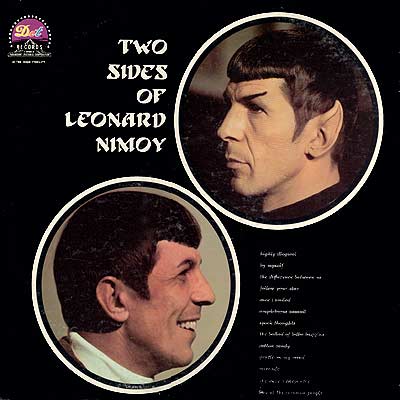
When I was younger, I had an album (actually, two,) recorded by Leonard Nimoy in which he (among other things, including, yes, singing,) read the poem "Desiderata."

The poem has a line that goes like this, "Do not compare yourself to others, for there will always be greater and lesser persons than yourself." Ah, if only I could listen to that most excellent advice. It would spare me the heartache (and carpel tunnel) of constantly checking my Amazon.com sales ranking and comparing it to that of other writers I know. (And then doing the evil dance of glee when mine is better.)

My biggest problem is that my powers come from the Dark Side of the Force. Fear, anger, and jealousy motivate me, particularly my writing life.

If I may talk seriously about this for a moment. Fear is something I think every creative person should experience. Why? Because if you're not a little bit afraid, it means you're probably not challenging yourself. It means that you're sticking to what's safe.

Jealousy... well, that's just my evil Scorpio nature. When someone I know who is also a professional writer does something I wish I were doing (selling more short stories, writing a better book), I find myself deeply inspired. I want what they have. This desire tends to light a fire under my butt. That can be a very good thing for me.

Anger. There is a part of me that wants very much to "show them, show them all" that I can rise above whatever box it is I feel I've been shoved into. The anger I have over my past publishing life gets turned around into this burst of "you'll never defeat me!"

But compulsively comparing my Amazon.com sales ranking to other writers? Not very helpful.

I know a lot of writers who get get caught up doing this. We try to figure out what it means... oh, look, I've gone up 1,000 -- will I be the next Dan Brown??

I think the reason we do this kind of "reading the entrails" has to do with the fact that so much of a book's success is completely out of our hands. Fate has, it seems, a lot more to do with whether or not a book does well than writing a good one. I know lots of good books (not just my own) which have languished and died for the lack of an appreciative audience. What can a girl do? Not much other than pray for a miracle it seems.

And, of course, dust off her Leonard Nimoy vinyl and listen carefully to the words that begin, "Go placidly amidst the noise and haste...."

Friday, April 21, 2006

No Rest for the Wiccan...

Romance Junkie's Tracy Marsac gave Tall, Dark & Dead a 4.5!

Read her review at http://www.romancejunkies.com/artman/publish/article_5055.shtml

Tuesday, April 18, 2006

The Dreaded Synopsis

Interestingly, I'm in the middle of this process right now. My agent was curious what my plans were for Garnet after I deliver DEAD SEXY in late-May, so I started crafting synopses/proposals for the next books currently cleverly titled: GARNET BOOK III, and GARNET BOOK IV.

There are two times in which you may be required to write a synopsis. First, when you finish your first novel and begin the process of selling it, and, second, when you're selling the idea of the next novel to your existing publisher/editor. I have been fortunate that the majority of my synopsis writing has been in category two.

I don't imagine that's very typical, and it gives me a slightly skewed sense of how the proposal process works. Still, I've had a fair amount of experience writing synopses, and it's actually an exercise I kind of enjoy. I know, I’m sick. This is news?

I have a really great book that I would like to suggest to any of you who are sitting down to struggle with the proposal process. It's called YOUR NOVEL PROPOSAL: FROM CREATION TO CONTRACT by Blythe Camenson and Marshall J. Cook (Writers Digest Press, 1999). Chapter Six is the pertinent section and is worth, in my opinion, the entire cover price of the book (not to mention Amazon.com offers used versions much cheaper.)

The most important thing to remember about writing synopses is what they're used for. They are a shorthand for agents and editors to get a sense of what your story is about. Herein, lies the key. Just as in writing a short story, you need to lay out the conflict in the first sentence (or, at the very least in the first paragraph.) By conflict, I don't just mean the wham, bam exciting plot element. I mean the emotional conflict. What is it that compels your hero or your heroine to take on this adventure? What does s/he stand to lose? To win? Why is this story going to change the protagonist's life? What does your character want? To quote Philip Martin's THE WRITER'S GUIDE TO FANTASY LITERATURE: FROM DRAGON'S LAIR TO HERO'S QUEST, "As Kurt Vonnegut famously said, a story should start with a character who wants something, even if it’s just a glass of water."

In a synopsis you need to lay that stuff bare. Just spell out what is motivating your hero/ine. Then (and here's the part that's much tougher when you're distilling a 400 page manuscript into a ten page synopsis) tell us only what you need in order to explain how that person either gets or doesn't get what they want over the course of the novel. Sub-plots can be cut. Major plot points can be cut – but only if they don't reflect an answer to the question of how you character gets (or doesn't get) what they want.

Also, in a synopsis, there is not point to being coy. Just tell us what happens, no need to be clever or mysterious – particularly about the ending. Endings must be revealed, and they should give the reader a sense of resolution. Synopses are the opposite of "show, don't tell" – they're all about the telling.

Yet, with all this telling, it's very easy for a synopsis to start sounding repetitive, "and then, and then." You also need to stay on top of your storytelling game. Find a way to make what you're saying reflect the tone of the novel. Luckily, I write chatty, sassy novels, so my synopses can have clever asides or other kinds of sarcastic comments – which may be why I find the writing of them much more fun than most people do.

Ah, yes, there are a couple of rules to writing synopses that I forgot to mention. Regardless of how the book is written, synopses must be in third person (he, she, it) and in present tense (is, am, are). There's also some formatting requirements, but you can find those in books like the one I mentioned above.

If you want to see an example of a synopsis, I have one on-line (for my alternate personality, so I guess the cat’s out of the bag) here: Messiah PDF (It's in PDF format.)

Wednesday, April 12, 2006

The Writing Life

I've gotten into the portion of the class where we talk about the life of writing (as opposed to the craft), and so I've stopped cross-posting here because, frankly, I find talking about manuscript preparation extremely boring. Important information, but boring to convey. If someone checking in is interested in all that jazz, let me point you to this extremely helpful website: http://www.sfwa.org/writing/. All the articles about writing are great, but the ones about the business of writing are especially useful, in my opinion.

So, I’ve been at a bit of a loss as to what to say here about writing. I stumbled across this question from Jennifer Pelland at the Live Journal community Serious Writers. Which is, "how much attention should a writer expect from an editor?"

Jen is asking in terms of a short story editor, I believe, and my experience with short story editors is that you hear from them three times -- once at acceptance, then just before publication when you're asked to check over your page proofs, and lastly when you get your check and contributors copy(s).

Novel editors... I've found that I like to keep in fairly regular contact with my novel editors, even if we're chatting about something only just tangentally related to the book. My experience is that a talkative novel editor is MUCH preferred to a silent one.

Tuesday, April 11, 2006

Saturn Direct!

Because I know you count on me for these kinds of astrological updates... here's the newest "Astro Alert" which I received compliments Astrology.com

"Saturn is often considered the Taskmaster Planet, and when it's retrograde? Well, there's no two ways about it: Issues of authority come to the fore, and a conservative attitude toward responsibilities creeps into even the most free-spirited souls. Whether consciously or not, you've probably been experiencing Saturn's four-and-a-half-month retrograde as a time to reflect on past decisions and learn from your mistakes ... but definitely not a time to easily charge toward your goals. Well all that's about to change as Saturn turns direct on April 5!"

Time to charge towards our goals, people.

Mine? Get more sleep!

More about Tall, Dark and Dead

Charlaine Harris reviewed Tall, Dark & Dead on the Books & Blog section of her website. A highlight: "I think it’s fair to say that if you enjoy my work and MaryJanice Davidson’s, you will like Tall, Dark and Dead."

It's less than a month away until the book hits the shelves!

Monday, April 10, 2006

4 STARS for TD&D!!

Romantic Times liked me, they really liked me...

"Call it sexual attraction. Call it fear. But whatever name you attach to Garnet Lacey's attraction to the new man in her life, Sebastian Von Traum, it is definitely connected to her past -- and, even more definitely to her future. Garnet is a witch who has vowed never to practice magic again -- even though part of the goddess Lilith (said to be on the dark side of the divine) resides in her. Furthermore, she senses absolutely no aura when she's around Sebastian. Is he a witch? Vampire? Ghost?

Garnet knows she should strive to get as far away from Sebastian as she can. Nearly a year ago, Vatican assassins destroyed her entire coven and she fled. She doesn't want to restart her old life ever again. Can Garnet and Sebastian find a way to work together to evict Lilith from Garnet, while at the same time keeping Sebastian safe?

Hallaway presents a terrific and enjoyable read. The characters are lively, and the story stays strong and balanced throughout. With a short conclusion, readers can onlyhope there will be a sequel. -- Robin Taylor

Promotional Fever

Sorry I've been absent for a while. I've got "a lot on" as the British might say. Not only am I in the middle of major revisions of Dead Sexy, the sequel to Tall, Dark &Dead but I also foolishly agreed to judge Mid-Michigan RWA's Happily Ever After romance contest for unpublished writers, *and* review an article for a scholarly journal about romance writers. Both of which just happen to be due in about twelve days (not the book, though, that's due at the end of May).

Also, I'm about a month out from the street date of Tall, Dark & Dead so I've been kind of in a promotional fever. I've been addressing postcards to independent bookstores, libraries, and the like. I've updated my website. Booked a few signing/reading gigs. Designed and submitted an ad for WisCON (a science fiction convention I'll be attending.) And generally running around like a chicken with my head cut off, "Book! Book! My book is coming out! Book!" (You can hear the chicken, right?)

If you've never hopped over to my web site -- www.tatehallaway.com, there is now also a rather long excerpt of Tall, Dark & Dead to whet your appetite. It's the entire first chapter. Enjoy.

I've done a lot of self-promotion over the years and I've always wonder what REALLY works. How do YOU decide to pick up a book? Is it through reviews? Meeting the author at a convention? Noticing an ad? Having your friendly, neighborhood bookstore clerk suggest a title? Browsing? What?

Okay, back to postcards addressing! Whee.

Wednesday, April 05, 2006

A New Review of TD&D

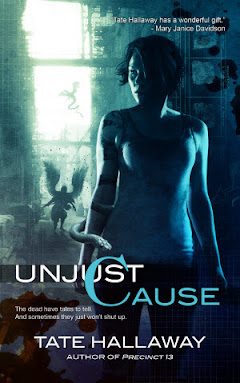
The Page Boy (E.B. Boatner) had this to say about Tall, Dark & Dead in the Minneapolis/St. Paul GLBT Magazine Lavender.

The last line of the review is a bit baffling. I read it twice and am still not entirely sure how to take it.

However, I met Mr. Boatner for coffee the other day and he expressed enthusiasm for the book, so my guess is that I'm to read that line as "I wish I'd written a book this cool," not "This is so fucked up, I wish I were making it up, but I'm not."

Oh, and please note that at the time I was posting this the picture and the review did not match. My cover is in front of the review for Michael S. Berman and Laurence Shames' Living Large and visa versa.

Tuesday, April 04, 2006

Random Thoughts at Midnight

Wondered about this last night...

...do you suppose all those people who won a "lifetime supply" of Rice-o-Roni (the San Francisco treat) on The Price Is Right are still getting it?

Thursday, March 30, 2006

Stupid Heros, Stupid Heroines

Having a clever, intelligent partner can be so annoying.

Sometimes, like with this novel, when I'm writing without a proposal/outline I get stuck. Usually, what is required is dinner out with my above mentioned sweetie and a couple of glasses of wine. I find that talking my plot out loud can really point out its flaws. It's like the advice a lot of novice writers get about reading their dialogue out loud to "hear" how it sounds on the page. When I start going through my, "And then she, and then she...." I can sometimes notice the gaps in my thinking. Especially when I get to the part last night where I said, "And, only I don't know how to get them out of this one! What would you do?"

Of course, like every ego-sensitive writer, *I* would like to be the one pointing to the flaws, but, whatever. Even when I'm cranky about hearing it, I trust my partner's plot sense. (She reads a LOT more than I do.) Unfortunately, last night's discussion is going to put me back about twenty pages. I hate that.

Still right is right. It's got to be fixed.

Part of it has to do with the fact that I know that, as a reader myself, I absolutely hate it when things don't make sense simply because an author wasn't willing to tell a truth that's inconvenient to her plot. You know what I'm talking about. The heroine is being chased by the cops, but somehow, when she gets back to her apartment, they're not there waiting there for her. She has time to take a nap, read a book, and talk to six people before there's a knock on the door. Okay, so that's exactly what _I_ just wrote, and so you can see the problem. It's just not true to life. At the very least, my heroine has to be cautious when heading home or the whole thing just starts to look a little too convenient or she seems a little too stupid, you know?

Stupid heros/heroines are the number one reason I get turned off as a reader. (Of course, that's provided I picked up the book in the first place.) I really like to be able to understand-–if not directly relate to--the choices the main character makes. Preferable is the heroine who is cleverer than I am. I like reading stuff that makes me say, "Oh, THAT was smart! I'll have to remember that the next time I'm being chased across a desert by a wombat!" Which is probably why when I stray from SF/F, I tend to read mysteries. People who can solve murder mysteries are usually much smarter than I am.

So, if I disappear for a few days it's because I'm in a revision quagmire.

Wednesday, March 29, 2006

File This &%#! Under Information I Never Wanted to Know

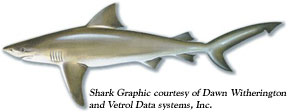
Bull sharks (carcharhinus leucus) can live in FRESH WATER, including rivers such as the Mississippi, and have been found as far north as Illinois!

Tuesday, March 28, 2006

Submission 101: Do You Really Have to Read Asimov's to Sell?

Yes.

If you want to publish SF/F/H/whatever you should read the magazines to which you want to sell.

In fact, instead of reading my blog, I think you should take a few minutes and check out Strange Horizons an online science fiction/fantasy magazine.

Of course, no one has the time to read every single issue of every genre magazine they might want to submit a story to. This is where having a writer's group is really helpful. My writers' group has sort of informally divided the work. Certain members read certain print magazines and report on them. A goodly portion of our workshop time we spend gossiping.. er, networking about the various markets – rumors we've heard about who's taking what, what kinds of stories they seem to prefer, who's overstocked, and notes on rejections (i.e. "we seriously considered your work, but, alas, we have three elf cowboy stories in the queue right now.")

If you don't have a writers group, there are places to catch up on this kind of information. Ralan's Webstravaganza and Speculation's Rumor Mill.

But, if you're reading the magazine, you can sometimes spot trends on your own. For a while it seemed you could sell anything involving a cat to Gardner Dozois. This is helpful if you have a cat story handy, not so much if you think that by writing a story about cats you will instantly sell.

Plus, there's the whole karma thing. My feeling has always been if you want science fiction short story markets to pay money to publish you, you need to make sure they stay in business by paying money to read the stories they paid other authors for. Plus, c'mon. Most subscriptions are not only fairly inexpensive, you can also write them off on your taxes.

Karma. Don't mess with it.

Seriously, I had a weird experience once that convinced me that reading short stories actually helped me understand them. Before I'd published my first novel, or really had a pro sale of any kind, I sat down one Thanksgiving weekend when I was stuck up in Grand Rapids, Minnesota visiting the in-laws and read an entire short story collection. Cover to cover. A week or so after that, I wrote a short story that would later become my first professional sale (seven cents a word, no less! Still the best, I think, I've ever been paid). I'm convinced it was a kind like when people go off to language camp to be completely immersed in a particular language in order to break through into fluency.

So go read stuff.

More Mason Humor

What do you call a cranky bee?

....a GRUMBLEbee.

Thursday, March 23, 2006

Future Farmers of America

Remember way back when I said I was working on an erotica piece? Well, I sold it. It will be appearing in Periphery -- Erotic Lesbian Futures (tentative title) under my OTHER name, along with such other amazing and talented writers as: Nicola Griffith, Catherine Lundoff, Gwyneth Jones, Marianne de Pierres, Cecilia Tan, and Melissa Scott.

This short story was really hard for me to write. I mean, it was just a pain in the ass (and not in the fun erotica way, either). I think it went through three complete drafts and took me three months to hammer out. What's funny about it is that the sex in it got less and less graphic the more I rewrote it. It went from fairly hot to what they'd call in the romance genre "sweet."

The reason the blog title is what it is because in one of its previous incarnations "istartu" (the name of the short story) had its climatic scene (yes, in the fun erotica way) on a farm. I ended up changing that for the final version because it wasn't terribly important to the plot, and in fact, had simply given me an excuse to meander through the scenery for a while.

Anyway, I'm kind of sad I ended up axing that now, if only because I don't think you see enough African-American lesbian farmers in science fiction.

Seriously, I was thinking about this in terms of what we talked about in class last night (which was overused F&SF cliches). One of the things we left with was the fantasy cliche of a world which appears to only produce adventurers and no one actually does the labor required to sustain a viable economy. I started thinking -- are there are lot of farmers in space? Not really. Okay, Luke Skywalker was a moisture farmer on Tatoonine. But, the farm existed as something to escape. I mean, it had to be literally torpeodoed for him to get his butt off-world and on to the work of becoming another science fiction/fantasy cliche -- the lost heir with the secret powers to defeat the evil empire.

James T. Kirk was from Iowa, but I don't think that should count. (Sorry, JPJ!)

Seems to me the girlfriend in "Vampire Hunter D" lived on a farm in the future (complete with ravenous mutants as a kind of stand-in for the coyote/wolf), but for some reason monsters and farms go hand-in-hand. (I just watched "Wallace and Gromit: Curse of the Wererabbit." What a hoot! And also all about monsters and farms -- or at least veg!)

On a whim I checked into Adherents (a great resource for religion in SF) and found a few entries under Amish in Science Fiction. But, there's not a lot.

Of course, Serenity/Firefly had a kind of rancher feel to it, but I think that's one of the reasons a number of SF fans couldn't really grok it. The whole farm/frontier thing rang too much of Westerns, than SF.

I wonder why farms and farmers have not had their day in SF? I mean, I had some fun imagining farming in the future. (I went for the bio-dome myself). Anyway, I think that there's a lot about the current state of farming, particularly in America, that lends itself well to a dark, cyberpunk future. My sense is that family farms are becoming a thing of the past -- and who better to be a villian in a cyberpunk story, but THE CORPORATION??? It's not like farming isn't fraught with conflict and tension.

Maybe I should challenge myself to write an SF story that takes place on a farm of the future.

Hmmmmmm.

Tuesday, March 21, 2006

*Cricket*, *Cricket*

Sorry I've been so quiet. Actually, I've been cheating on you. I joined one of those Live Journal communities (one called whileaway, which is a feminist fantasy and science fiction literature group) in order to talk more about books – actually, a certain book, and I've already wrote a missive about it here, and I really wanted more than what you gave me.

Well. Now the cat's out. Try not to cry. I still love you.

Anyway, I was talking to my friend April the other night and we both agreed that it's really kind of a shame that you can walk up to almost any science fiction fan and talk about the latest movie or TV show (ah, Battlestar Galactic-crack!) – but there's no place you can go where you're guaranteed to find someone who's read whatever book has been turning you on lately. You can surf the web for reviews, but that's not terribly interactive, you know?

I'm not trying to be some kind of literature snob here, because I'm not. I came into science fiction fandom by way of media. I saw Star Wars sixteen times in the theatre, and still didn't feel done with it. At my local library, some incredibly clever librarian put the Star Wars novelizations and books like Han Solo's Revenge right there in the science fiction section, so that when I finished with those I just randomly picked up one of the other SF books. I believe it was either one of the Nebula collections of short stories or possibly Philip Jose Farmer's Jesus on Mars, (which might explain a lot about my alternate self, wouldn't it?)

The point is, I enjoy talking media as much as the next geek, but I think part of the problem is that there's no way a person can keep up with all the SF&F and related genre books that come out in any given year. There's just too many. So finding six other people who happened to all pick up the same book (and who found time to read it) is pretty tough. And, of course, most books I read for pleasure don't make me really wound up. It's a rare book that gets me hopping – well, anything, mad, happy, torqued. Even books that make me think don't always get under my skin, you know?

Like the book I'm reading right now. It's called A Spectacle of Corruption by David Liss. It's a good book so far (I'm on page 88), but it's not SF or F. It's a mystery (my other genre of choice), and a historical one at that. I don't think it's going to be something I'll want to shout about though, other than the usual: hey, here's a good book.

This is an interesting thought, I suppose. I mean, is the point of writing to make someone think? Obviously, I don't think so. I generally write "beach books." I've always maintained that my whole purpose in writing to tell a "ripping good yarn." So... so what? What's my point? My point is that it's all good, but when a book makes you think it'd be cool if there were a bunch of people waiting in line to talk about it with you, don’t you think?

Wednesday, March 15, 2006

And Now Back to Vampires

So I took the dumb vampire quiz: "What Type of Vampire Are You? expecting to be annoyed by the answer, but, no, this is totally the kind of vampire I find hot (and thus, would like to be):

Walking Sex Vampire
Walking Sex Vampire

What type of vampire are you?
brought to you by Quizilla

Mercury Retrograde and Other True Tales of Magic

Do you know that saying about the gods of Cthulhu? The more you become aware of them, the more they’re aware of you? I think magic is like that (and astrology, too).

Here's my story. I have this ritual I do every calendar New Year. On New Year's eve, I take a number of dimes (I think it started at five and we've added one every year we've been doing this) and wrap them in a gold colored silk scarf. I place the scarf outside on our doorstep (hidden from the neighbors, of course.) We leave it there overnight. The idea is that the physical act of bringing the money inside the next day represents being receptive to good fortune, particularly in the form of cash, throughout the upcoming year.

Well, this year we forgot about our dimes for a couple of days.

And I have to say there have been a number of things that make me feel like this is exactly what's been happening to us this year in terms of my incidental writing money. Like, so far, it hasn't been anything big, but there are a number of short stories that I have out to market which have made it past various first cuts (or so the editors have informed me), but which seem to have gone into a kind limbo ever since getting the initial good news. Similarly, my agent sold Japanese rights to books I wrote under another name and the IRS and I have been back and forth (with my tax consultants acting as an intermediary) over one silly little form which means the world of difference in how I get taxed on such things. In other words, the money is there, it's just being held up.

Weird, huh?

And, of course, Mercury is retrograde (and has been since March 2).

Don't you just hate it when that happens?

Sure, you do. You just don't know it. Thing is, if I tell you want Mercury in retrograde means, I know you're going to find yourself suddenly aware of its effect on your life. I know, because this is exactly how I got sucked into astrology.

I get these silly little astrology alerts about various retrograding planets, and here’s what Astrology.com says about Mercury: “It's that time again: Mercury turned retrograde on March 2, and will continue its apparent backward journey until the 25th. Better dust off all the standard Mercury-retrograde cautions: Back up computer files and go the extra mile to express yourself clearly. When the Communication Planet is in reverse, it can feel like productivity is in park! But no two retrogrades are the same -- and Mercury's latest move makes this a crucial time to strike new balance."

"Mercury retrograde is always cause for introspection -- even more so as it takes place in Pisces, the imaginative final sign of the zodiac. The Fish swim through deep, dreamy waters, so pay close attention to your subconscious cues for the next few weeks. Reason may be particularly obscured, but as typical modes of communication become tricky, we'll all benefit from indulging those creative sides!”

For me, Mercury in retrograde usually means I should shut the hell up. So I will.